
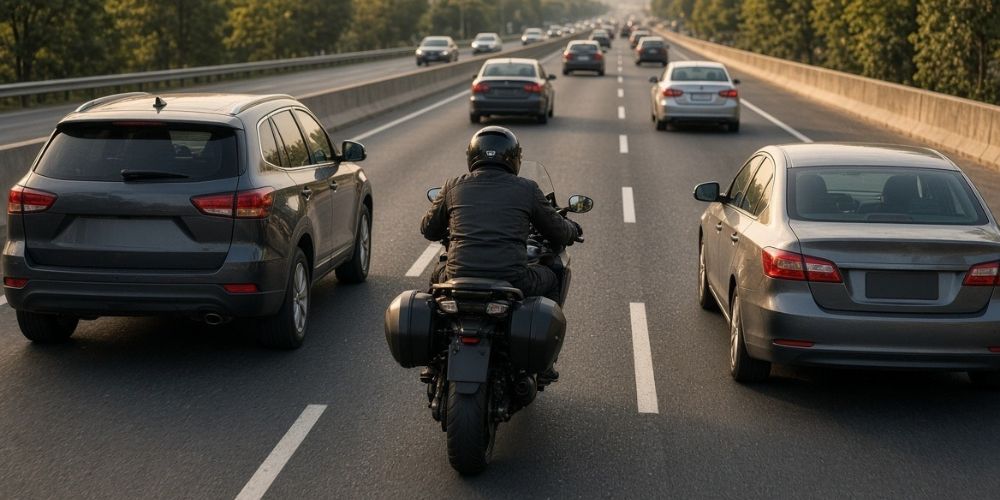
Motorcycle riders frequently face congested roadways, and the space between lanes of slow or stopped traffic may appear to offer a practical route forward. Some states have adopted limited rules that permit certain forms of this practice. Texas has not. Texas lane splitting laws restrict motorcyclists from riding between lanes of traffic, and those restrictions can affect more than the possibility of a citation. They may also influence how responsibility is evaluated when a crash occurs.
This article explains what Texas law provides, what it permits, and how it may bear on a motorcyclist’s injury claim.
Is Lane Splitting Legal in Texas?
No. Texas law prohibits the operator of a motorcycle from riding between lanes of traffic moving in the same direction. The law also prohibits a motorcyclist from passing another vehicle while remaining in the same lane as the vehicle being passed.
The Legislature addressed this subject directly in 2023. Before that time, the practice was commonly described as unclear under Texas law, and older articles may still reflect that description. The current rule is specific.
As written, the prohibition does not contain an exception for slow or stopped traffic. The only exception applies to police officers acting in the performance of their official duties.
What Is the Difference Between Lane Splitting, Lane Filtering, and Lane Sharing?
The terms used to describe these practices vary, and Texas law does not use them. In general:
| Lane Splitting | Lane Filtering | Lane Sharing | |
| Common meaning | A motorcycle traveling between lanes of moving traffic | A motorcycle moving between lanes of slow or stopped traffic | Two motorcycles traveling side by side within a single lane |
| Typical situation | Riding between vehicles on a highway or roadway while traffic is moving | Approaching the front of a line of vehicles at a traffic signal | Two riders traveling together in one lane |
| Position on the roadway | Between lanes | Between lanes | Within one lane |
| Treatment under Texas law | Prohibited | Prohibited | Permitted, limited to two motorcycles abreast |
The Texas restriction is broader than any of these labels. Because it prohibits operating a motorcycle between lanes of traffic moving in the same direction, lane filtering in Texas is subject to the same restriction as lane splitting. A rider who is moving between stopped vehicles is not exempt from the rule.
In addition, driving on the shoulder to bypass traffic is generally restricted under Texas law, subject to limited exceptions. The shoulder should therefore not be regarded as an alternative.
What Motorcycle Lane Rules Does Texas Law Permit
Texas motorcycle lane rules also contain protections for riders. Under Texas law:
- A motorcycle is entitled to the full use of its lane.
- Other drivers may not operate a vehicle in a manner that deprives a motorcycle of full use of that lane.
- Two motorcycles may be operated side by side within a single lane.
- More than two motorcycles abreast in a single lane is not permitted.
The protection against being crowded out of a lane is significant. A driver who passes closely within a motorcycle’s lane, or who drifts toward the lane line until the rider has insufficient space, may be violating the rider’s right to the full lane. Such conduct can be relevant when responsibility for a collision is determined.
All drivers, including motorcyclists, are also expected to remain as nearly as practical within a single lane and to change lanes only when the movement can be made safely.
What Are the Penalties for Lane Splitting in Texas?
A violation of the lane rules is a traffic offense, and a law enforcement officer may issue a citation. The specific consequences depend on the charge, the court, and the circumstances of the stop. A rider who receives a citation should consult a qualified attorney regarding the particular facts.
For many riders, the citation is not the most significant concern. A greater concern is the manner in which an alleged violation may be used against the rider in a civil claim following a crash.
Why Riding Between Lanes Creates Additional Risks
Apart from the legal restrictions, riding between vehicles presents practical hazards:
- Blind spots. Motorcycles are smaller than most vehicles, and a driver may not see a motorcycle traveling alongside.
- Lane changes. A driver who changes lanes without adequate observation may not anticipate a motorcycle in the space between vehicles.
- Limited room to react. A vehicle door opening, a driver adjusting position within a lane, or debris near a lane line can leave a rider with very little margin.
- Unexpected movement. Many drivers do not expect a motorcycle to pass between lanes, which can make their reactions difficult to predict.
On congested corridors throughout the Rio Grande Valley, stop-and-go traffic may increase both the incentive to ride between vehicles and the likelihood that a rider will not be seen.
Lawful Ways to Manage Heavy Traffic on a Motorcycle
Riders who wish to remain safe and within the law in congested conditions may consider the following:
- Maintain a safe following distance to allow adequate time and space to stop.
- Position the motorcycle within the lane where it is most visible to drivers ahead and behind.
- Avoid the blind spots of other vehicles, particularly large trucks.
- Use signals consistently and keep the brake light visible when slowing or stopping.
- Plan routes and travel times to avoid the heaviest congestion where possible.
- Wear protective gear on every ride, including a helmet. The effect of helmet use on a claim is discussed in our article, How Do Texas Helmet Laws Impact Motorcycle Accident Claims?
Additional rider safety resources are available from the National Highway Traffic Safety Administration.
What Are Other Drivers Required to Do Around Motorcyclists?
Motorcyclists are entitled to the full use of their lane; other drivers must take reasonable care to avoid interfering with their path or creating a collision risk. Drivers should:
- Check mirrors and blind spots carefully before changing lanes.
- Avoid following a motorcycle too closely or drifting toward the lane line beside it.
- Look carefully for motorcycles at intersections and before turning.
- Avoid distractions, including the use of a phone, while driving.
A driver who fails to meet these obligations and causes a collision may be held responsible, even where the rider was engaged in conduct that Texas law does not permit. The extent of that responsibility is addressed below.
How Can Lane Splitting Affect a Motorcycle Accident Claim?
A violation of a traffic rule does not automatically eliminate a rider’s right to seek compensation. Texas applies a modified comparative responsibility standard. In general, an injured person’s recovery is reduced by his or her percentage of responsibility for the collision, and a person found to be more than 50% responsible is barred from recovering damages.
If a rider was traveling between lanes at the time of a collision, the other driver or the insurance carrier may contend that the rider was partially or primarily at fault. Whether that contention is supported depends on the evidence, which may include:
- The position of each vehicle before the impact
- Whether the other driver changed lanes without adequate observation, failed to heed a signal, or was distracted
- Speed and traffic conditions at the time
- Witness statements, traffic camera footage, and dashcam video
- The contents of the crash report and whether it accurately reflects the event
Insurance companies may rely on an alleged lane-use violation to reduce or deny a claim. A thorough investigation can help establish what occurred and who was responsible. Fault in a motorcycle collision is frequently disputed, and each case depends on its own facts. Our article on how shared fault affects a car accident case in Texas discusses the same principles in greater detail.
What Should You Do After a Motorcycle Crash in Texas
Whether or not lane splitting is alleged, the following steps may help protect your health and your claim:
- Call 911 and seek medical attention. Certain serious injuries are not immediately apparent.
- Document the scene. Photograph the vehicles, the roadway, and any visible injuries if you are able to do so.
- Obtain contact information. Collect the names and contact details of other drivers and any witnesses.
- Use caution with insurers. Consult an attorney before providing a recorded statement to an insurance adjuster.
- Preserve evidence. Retain your helmet, protective gear, and damaged motorcycle, and keep medical records, bills, and documentation of lost income.
Texas generally imposes a two-year deadline for filing a personal injury lawsuit, subject to certain exceptions. Additional information is available in our article on how long you have to file an injury claim in Texas.
Consult a Motorcycle Accident Lawyer in McAllen
If you were injured in a motorcycle crash, the opposing party may rely on lane-use rules in an effort to assign fault to you. An experienced attorney can investigate the circumstances of the collision, explain how Texas law applies, and help you evaluate your options before you decide how to proceed.
Garza Law Firm represents injured motorcyclists in McAllen and throughout the Rio Grande Valley. To learn more about our motorcycle accident practice, or to schedule a free consultation, please call (956) 201-7787. Our personal injury clients owe no attorney fees unless and until we recover compensation on their behalf.


